Sheet 005 — 2026
Agent Replay: a calmer way to review code
Too many files, a wall of changes, and not enough time. Agent Replay brings the review back to one change you can actually follow.
01 / 05
The review starts with a wall of changes.
Open a sizeable pull request and the interface hands you a file count, a line count, and a long stack of red and green. Before reading the first function, you are estimating how much of your afternoon has disappeared.
The interface is part of the problem. Condensed diffs split a change across files and fragments; you have to rebuild the context and relationships while keeping track of what is left. When an agent produces code faster than you can absorb it, that review queue gets rather loud.
We built Agent Replay to bring focus back. Lines arrive and disappear smoothly, with the agent’s recorded explanation alongside the change. Your attention stays on what is happening now. Pause there. Understand that function. The rest can wait.
02 / 05
1. Open a session. Take your time.
With Node 20+ and git installed, run this from your repository:
npx agent-replay-studio@latestIt opens a local player and finds existing Claude Code, Codex, and Gemini CLI logs. Pick your project and a session. If your project is missing, use Open folder… in the project picker to point it at the repository. It still needs a supported session log or a saved replay to show that session.
Press Space to play or pause. Use → to finish the current animation or advance one step, and ← to go back. N jumps between review notes. Slow the playback down; the code has already been written. It can wait.
Open the file tree to see where each edit belongs. Switch to File for the surrounding function, or step back to its earlier state. You can follow what was added or removed without losing the file around it.
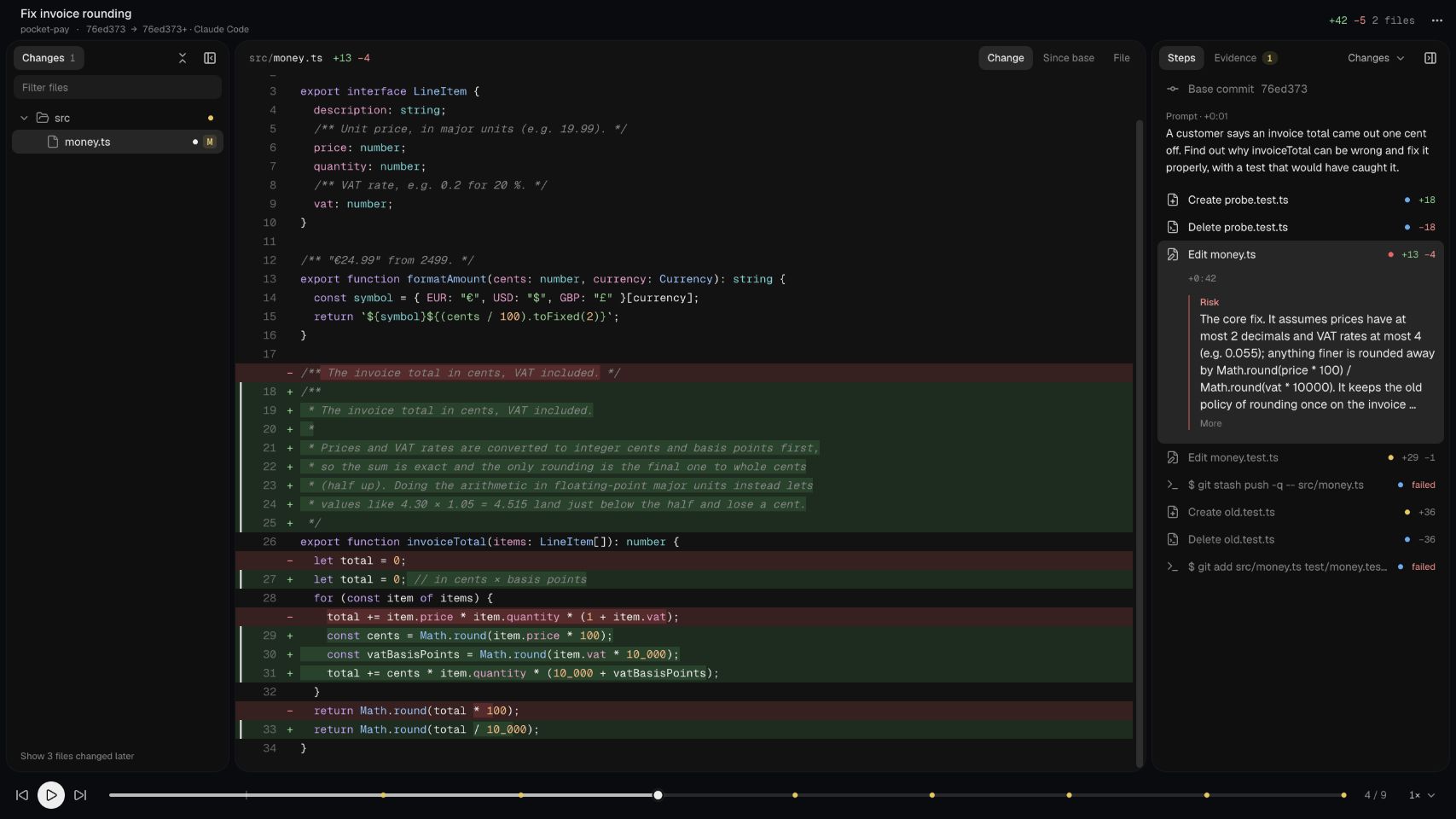
This is pocket-pay, a small demo we made. Its invoice total was one cent off. At the fix, a review note points out the assumptions: prices have at most two decimals, and rounding happens on the invoice total. Those are decisions worth reading before approving.
03 / 05
2. Look at what was actually checked.
Open Evidence. It lists recorded test runs and other recognized checks, their results, and things worth investigating: deleted tests, failures hidden by shell pipes, or edits after a passing check.
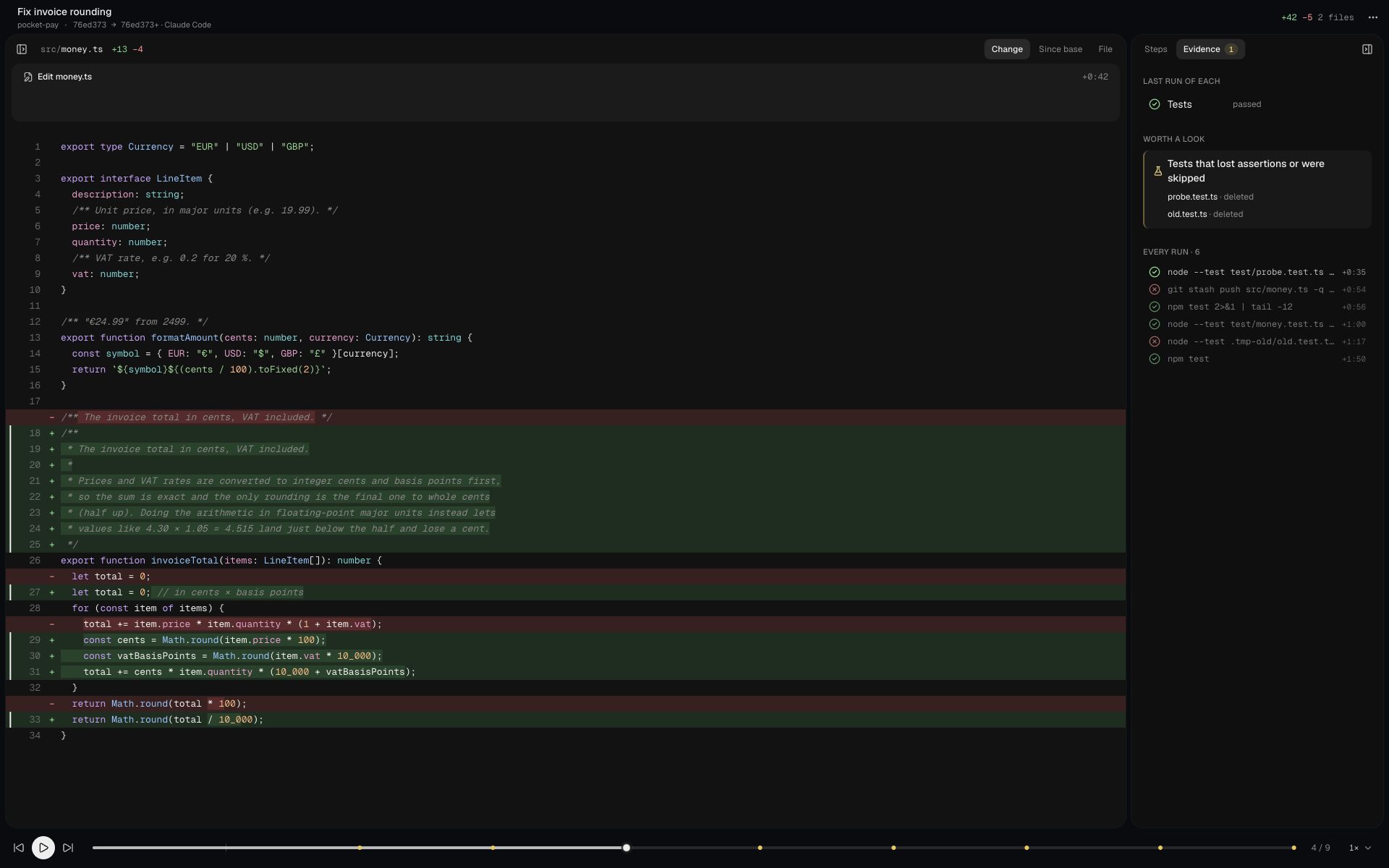
Here, the deleted files were temporary probes. One deliberately ran the new tests against the old implementation to confirm they caught the bug. The final suite passed. The warning gives you somewhere to look; the sequence gives you context.
The panel reads recorded commands and output. It does not rerun the tests or prove correctness. You still decide whether the implementation and its checks are sufficient.
04 / 05
3. Learn the part you are about to own.
Sometimes the missing piece is the repository itself. There are two ways in: replay its Git history commit by commit, or ask an agent to build concise tutorials that cover the current repository.
The history command lets you choose a starting revision with --from, including the first commit. Add --learn to introduce the files already present at that starting point, then follow the changes forward.
npx agent-replay-studio@latest history --learnWithout --from, history shows up to the latest 300 commits.
For Claude Code, install the teaching skills from your repository:
npx agent-replay-studio@latest skills installThen ask your agent:
Use replay-teach to teach me this repository in concise lessons. Start with the data types, follow one request, and explain the important decisions. Use the actual source and continue until the repository is covered, keeping boilerplate brief.
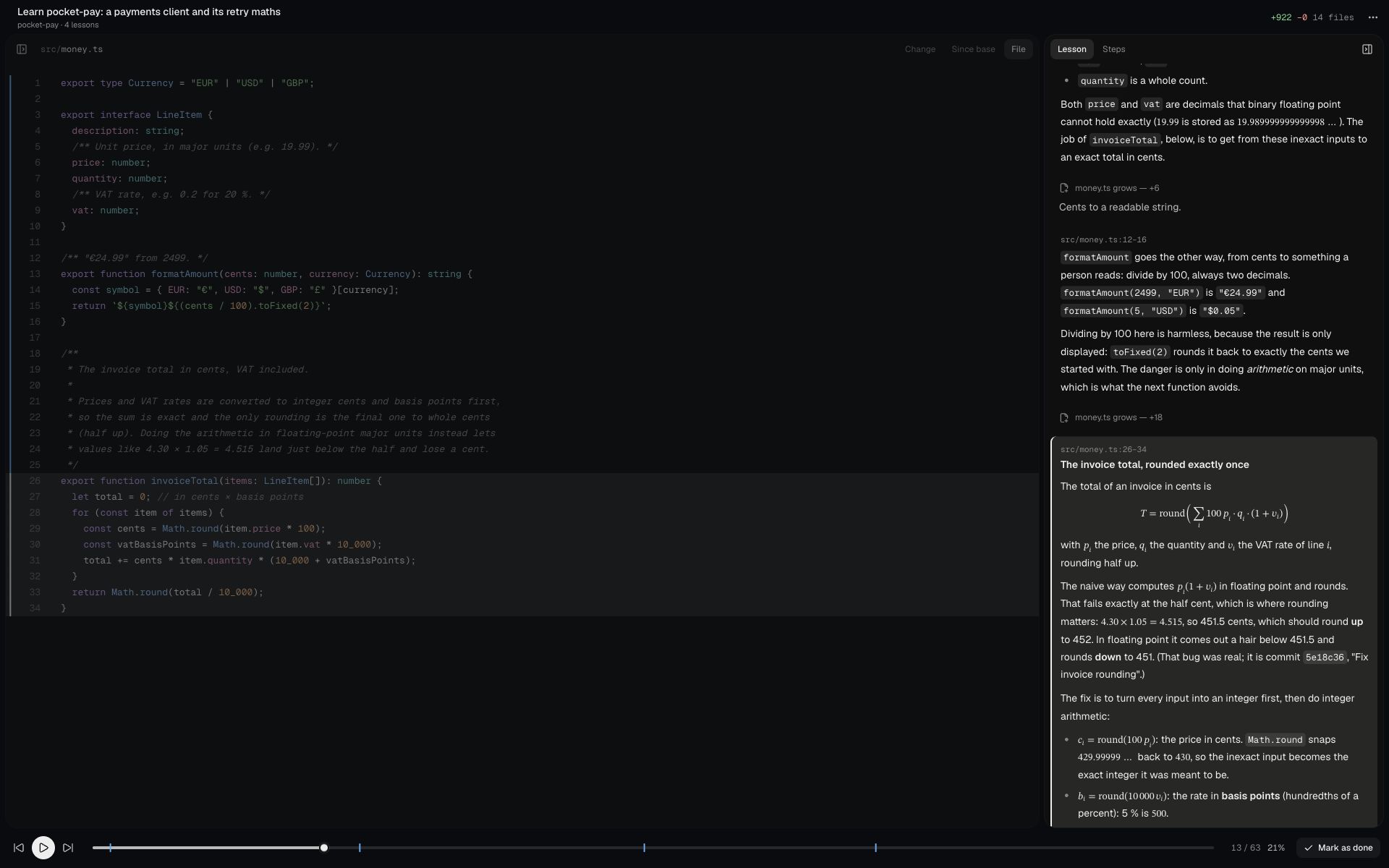
Open the course under Learn. Pause at a function, read its explanation, and follow the next piece when you are ready. Source is pinned to the course’s revision; the agent-written explanations still deserve your judgment.
05 / 05
Give the next reviewer a way in.
Export a replay as a self-contained HTML file that opens offline. Share it alongside the PR so someone else can follow the same steps. Check the export before sharing: it contains code and session context.
Agent Replay is open source on GitHub. Try it on one small change you would otherwise skim.
The agent can keep the speed. We get to keep a little understanding.